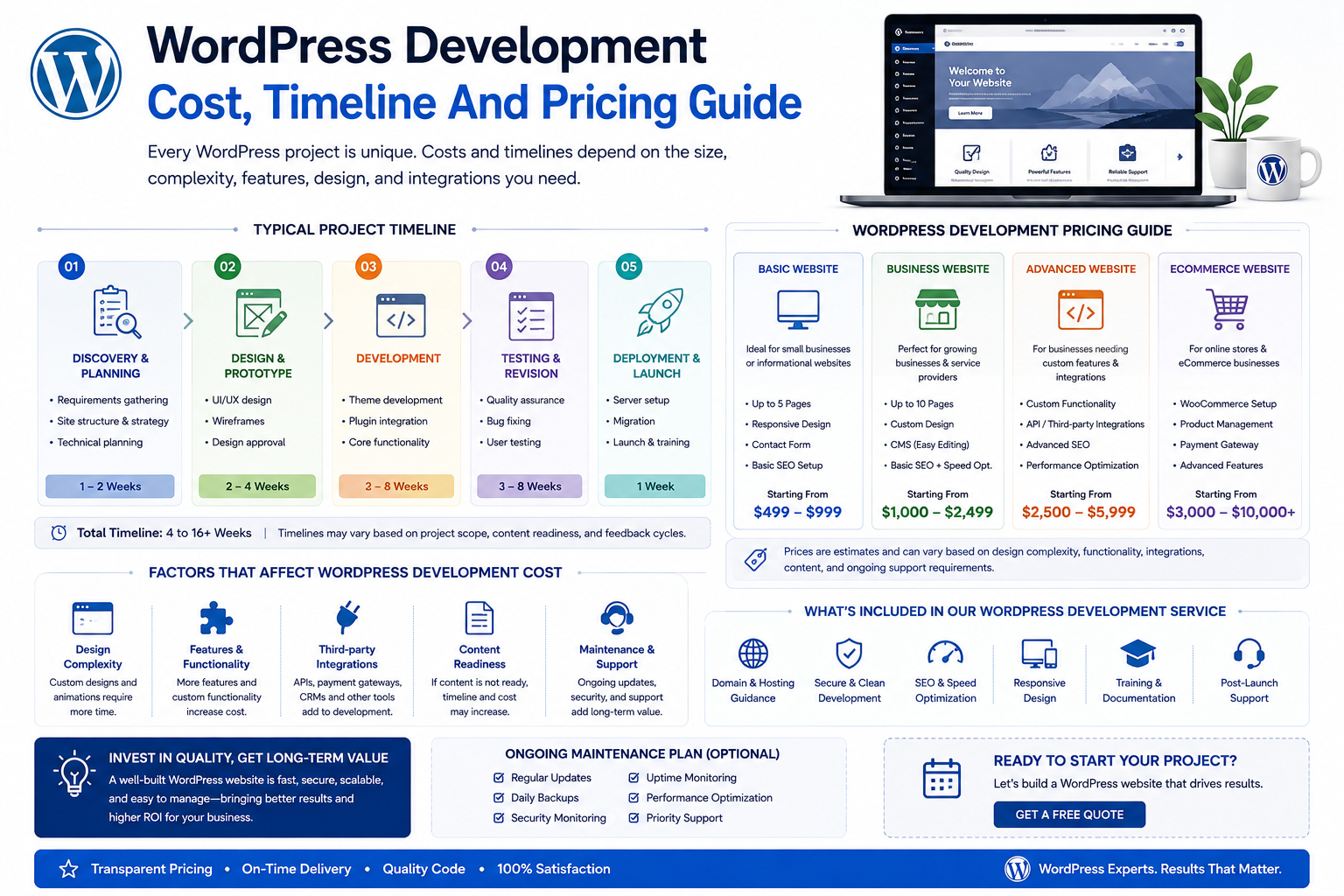
Planning a new WordPress website but unsure what it will cost or how long it will take? This guide gives you a clear, honest breakdown of WordPress development pricing, realistic timelines, and the decisions that shape your total investment — so you can plan with confidence and avoid surprises.
Comparing quotes rather than project timelines? This guide focuses on the planning decisions and stages that affect delivery. For fixed-scope, hourly, retainer and milestone-based pricing models, see our WordPress development pricing options comparison. The two guides answer related but different buyer questions.
What Drives WordPress Development Cost?
There is no single standard price for a WordPress site. Your final investment is shaped by a combination of technical scope, design complexity, and business requirements. At Adspheregroup, we clarify these drivers at the start of every project so your proposal reflects your actual goals — not a generic estimate.
1. Type of WordPress Site
The most fundamental cost driver is what you are building. A five-page brochure site is structurally different from a WooCommerce store with hundreds of products or a membership platform with gated content and user dashboards. More functionality means more planning, development hours, and testing cycles.
- Basic marketing or portfolio site — Home, About, Services, Contact, Blog. Minimal custom logic.
- Business or corporate site — Multiple service pages, lead capture forms, blog, and basic integrations.
- WooCommerce or ecommerce store — Product catalog, payment gateway, inventory management, and checkout flows. See our ecommerce website development service for details.
- Membership, LMS, or booking platform — Advanced user roles, gated content, scheduling logic, and third-party API connections.
2. Design Approach: Theme-Based vs. Custom
WordPress gives you two broad design paths, and the choice has a significant impact on both cost and timeline.
- Theme-based builds — Faster to deliver and more budget-friendly. A quality premium theme, configured and styled to your brand, can produce a professional result in a shorter timeframe. Best when your layout needs are standard and your brand guidelines are flexible.
- Custom-designed builds — Higher investment, but every pixel is intentional. Custom builds are the right choice when you need a distinct visual identity, unconventional page structures, or a user experience that no off-the-shelf theme can replicate.
Adspheregroup works across both approaches — WordPress core, page builders, and fully custom layouts — depending on your goals and budget constraints.
3. Functionality, Integrations, and Plugins
Beyond design, the features you need are a primary cost and timeline driver. Each integration must be configured, tested, and often customized to work reliably in your specific environment. Common factors include:
- Number and complexity of forms (contact, quote, multi-step lead capture)
- Third-party integrations — CRM, email marketing platforms, payment gateways, booking tools
- Advanced features — role-based content access, membership areas, custom admin dashboards
- Performance and security hardening beyond standard WordPress defaults
- Multilingual or multi-region requirements
A clear requirements list at project start is the single most effective way to receive accurate pricing. Vague briefs produce vague estimates — and often lead to scope creep later.
WordPress Development Pricing Tiers
The following ranges reflect real-world project costs across different complexity levels. Prices vary by region, agency size, and project specifics, but these tiers give you a reliable starting framework for budgeting conversations.
Tier 1 — Simple Business Website
Typical range: $1,500 – $5,000 USD
This tier covers a clean, professional website with up to 8–10 pages, a premium theme, standard contact forms, basic SEO setup, and mobile-responsive layouts. It is the right starting point for small businesses, freelancers, and local service providers who need a credible online presence without complex functionality.
What is typically included: theme setup and customization, homepage and inner page design, contact and inquiry forms, Google Analytics integration, basic on-page SEO, and a staging-to-live deployment.
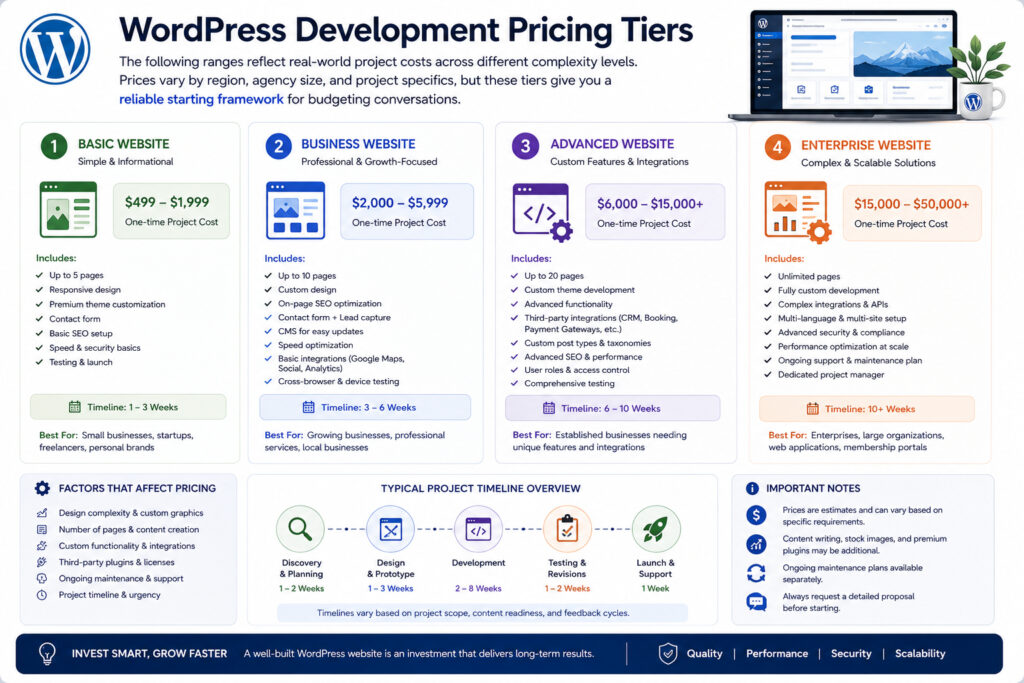
Tier 2 — Mid-Complexity Business or Service Site
Typical range: $5,000 – $15,000 USD
This tier suits growing businesses that need more pages, richer functionality, and tighter brand alignment. Projects in this range often include custom page layouts, CRM or email marketing integrations, blog setup with category architecture, lead generation funnels, and performance optimization. The design process is more involved, with wireframes or mockups reviewed before development begins.
Example: a professional services firm needing 20+ pages, a resource library, a contact-to-CRM workflow, and a blog structured for SEO would typically fall in this tier.
Tier 3 — WooCommerce or Advanced Functionality
Typical range: $10,000 – $30,000+ USD
WooCommerce stores, membership platforms, learning management systems, and booking-heavy sites fall into this tier. The complexity comes not from page count but from the logic required: product variations, payment gateway configuration, subscription billing, user role management, and the QA effort needed to ensure every flow works correctly before launch.
If you are also considering a Shopify-based store, our Shopify website development service may be worth comparing — the right platform choice can affect both your launch cost and long-term maintenance overhead.
Tier 4 — Enterprise or Fully Custom Builds
Typical range: $30,000 – $100,000+ USD
Enterprise WordPress projects involve custom plugin development, headless or decoupled architectures, complex API ecosystems, multi-site networks, or high-traffic infrastructure requirements. These projects require dedicated discovery phases, technical architecture planning, and ongoing post-launch support agreements. Pricing at this level is always project-specific.
Typical WordPress Project Timelines
Even projects with similar budgets can have very different timelines depending on how quickly decisions are made and content is delivered. Below is a practical phase-by-phase view for small to mid-sized business websites when stakeholders are responsive and requirements are clear from the start.
Phase-by-Phase Timeline Overview
- Discovery and planning (1–2 weeks) — Clarifying goals, target audience, key pages, required functionality, and technical constraints. This phase produces a written scope that aligns budget with outcomes before any design or development begins.
- UX, structure, and design (2–3 weeks) — Site architecture, wireframes or page outlines, and visual design directions. Theme selection or custom design concepts are finalized here. Feedback rounds are structured to keep this phase from expanding.
- Development and integration (3–5 weeks) — Building pages in WordPress, implementing and configuring plugins, connecting third-party integrations, and ensuring mobile-responsive layouts across devices and browsers.
- Content loading, QA, and revisions (1–2 weeks) — Adding copy, images, and media; identifying and fixing issues; refining layouts based on structured feedback; and preparing the site for launch.
- Launch and post-launch optimization (1 week) — DNS changes, final testing in the live environment, performance tuning, Core Web Vitals checks, and on-page SEO verification.
For very simple sites, this entire process can compress to 3–4 weeks. For complex builds with ecommerce, custom logic, or multi-region requirements, timelines typically extend to 8–14 weeks.
Common Timeline Risks and How to Manage Them
Most project delays do not come from WordPress itself — they come from project conditions. The most common timeline risks are:
- Slow content delivery — Copy, images, and product data that arrive late push every subsequent phase back. Providing content before development begins is the single highest-impact thing a client can do to protect their timeline.
- Scope changes mid-build — Adding features or pages after development has started requires re-planning and re-testing. New requests are always welcome, but they should be scoped and priced before work begins.
- Unclear decision-making — Multiple stakeholders with conflicting feedback or slow approval cycles are a leading cause of timeline overruns. Designating a single point of contact on the client side resolves most of this risk.
- Late discovery of integrations — A CRM connection or payment gateway requirement discovered in week four of a six-week project will extend the timeline. Thorough discovery at the start prevents this.
Adspheregroup manages these risks through clear written milestones, structured feedback rounds, and a defined scope document that both parties sign off on before development begins.
Ongoing Costs After Launch
WordPress development cost does not end at launch. Budgeting for ongoing maintenance is essential for keeping your site secure, fast, and functional. Common post-launch costs include:
- Hosting — Managed WordPress hosting typically costs $25–$100/month for small to mid-sized sites. High-traffic or WooCommerce stores may require $100–$500/month or more.
- Plugin and theme licenses — Premium plugins often carry annual renewal fees of $50–$300 each. Factor these into your total cost of ownership.
- WordPress core, theme, and plugin updates — Regular updates are required for security. A maintenance retainer from your development partner typically costs $100–$500/month depending on scope.
- SEO and content — Ongoing SEO work, blog content, and conversion optimization are separate from development but directly affect the return on your website investment.
- Performance monitoring — Tools and periodic audits to ensure your site remains fast as content and plugins accumulate over time.
How to Get an Accurate Quote for Your WordPress Project
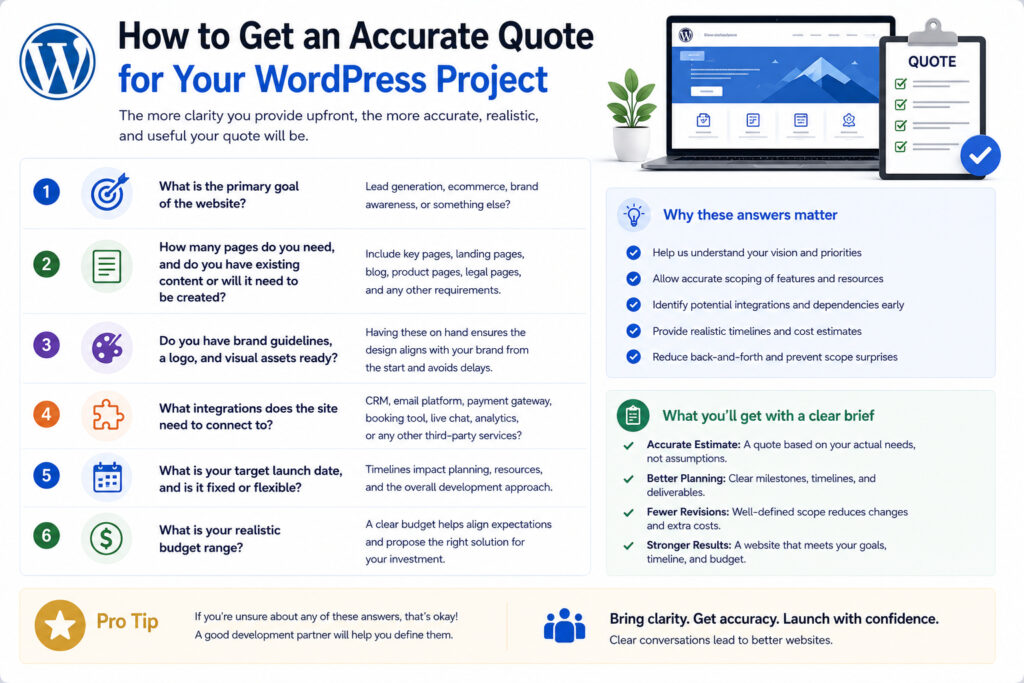
The most reliable way to receive an accurate quote is to arrive at the conversation with a clear brief. You do not need a technical specification — you need answers to a few practical questions:
- What is the primary goal of the website — lead generation, ecommerce, brand awareness, or something else?
- How many pages do you need, and do you have existing content or will it need to be created?
- Do you have brand guidelines, a logo, and visual assets ready?
- What integrations does the site need to connect to — CRM, email platform, payment gateway, booking tool?
- What is your target launch date, and is it fixed or flexible?
- What is your realistic budget range?
Bringing clear answers to these questions allows any competent development partner to provide a meaningful estimate rather than a wide range that is difficult to plan around.
Why Choose Adspheregroup for WordPress Development?
Adspheregroup delivers WordPress development for businesses across the USA, Canada, Australia, and India. Our work spans simple business sites, complex WooCommerce stores, and custom-built platforms — always with a focus on performance, SEO readiness, and long-term maintainability.
We combine development expertise with SEO and conversion thinking from day one, so your site is not just built — it is built to perform. If you are also evaluating Shopify as a platform, our Shopify development service and Shopify readiness framework can help you make the right platform decision before committing to a build.
Summary: WordPress Development Cost and Timeline at a Glance
WordPress development costs range from approximately $1,500 for a simple business site to $100,000 or more for enterprise-grade custom builds. Timelines run from 3–4 weeks for straightforward projects to 12–14 weeks for complex ones. The most important variables are site type, design approach, required functionality, and how prepared you are with content and decisions when the project begins.
If you are ready to discuss your project, contact Adspheregroup for a scoped estimate based on your specific requirements — not a generic range.