If you are planning a new WordPress website or a redesign, the first question is usually the same: how much will it cost, and what should I expect for that budget? This guide walks you through the main cost options, what drives price up or down, and how to avoid common surprises so you can brief your developer or agency with confidence.
WordPress development pricing: which quote model fits your project?
Searches for WordPress development pricing usually mean the buyer wants to compare realistic engagement models, not receive an unqualified “website from $X” promise. The price ranges later in this guide are illustrative planning examples—not a current Adspheregroup fixed-rate price list, independently surveyed market averages or guaranteed quotations.
| Model | Best fit | What to confirm before signing |
|---|---|---|
| Fixed-scope project | Defined brochure site, redesign or known feature set | Pages, revisions, content inputs, integrations, acceptance tests, exclusions and change requests |
| Hourly / time-and-materials | Bug investigation, uncertain plugin conflicts or evolving requirements | Rate, estimate band, timesheets, approval threshold, reporting cadence and stop-work rules |
| Monthly maintenance retainer | Updates, monitoring, small improvements and ongoing support | Included hours, security scope, incident response, backups, hosting and work outside the retainer |
| Milestone-based custom build | Complex design, WooCommerce, membership or API work | Deliverables, access to source code, ownership, staging, payment milestones and release acceptance |
Ask for a comparable WordPress quote
Send each agency the same brief: business goal, number of templates rather than just pages, copy/design responsibilities, ecommerce or integrations, current hosting, accessibility requirements and post-launch support. Request the assumptions that could change cost. For project timelines, phases and risk management see our separate WordPress cost-and-timeline planning guide. To discuss an actual scope rather than a generic estimate, use the Adspheregroup project enquiry page.
Typical WordPress Cost Ranges and What You Actually Get
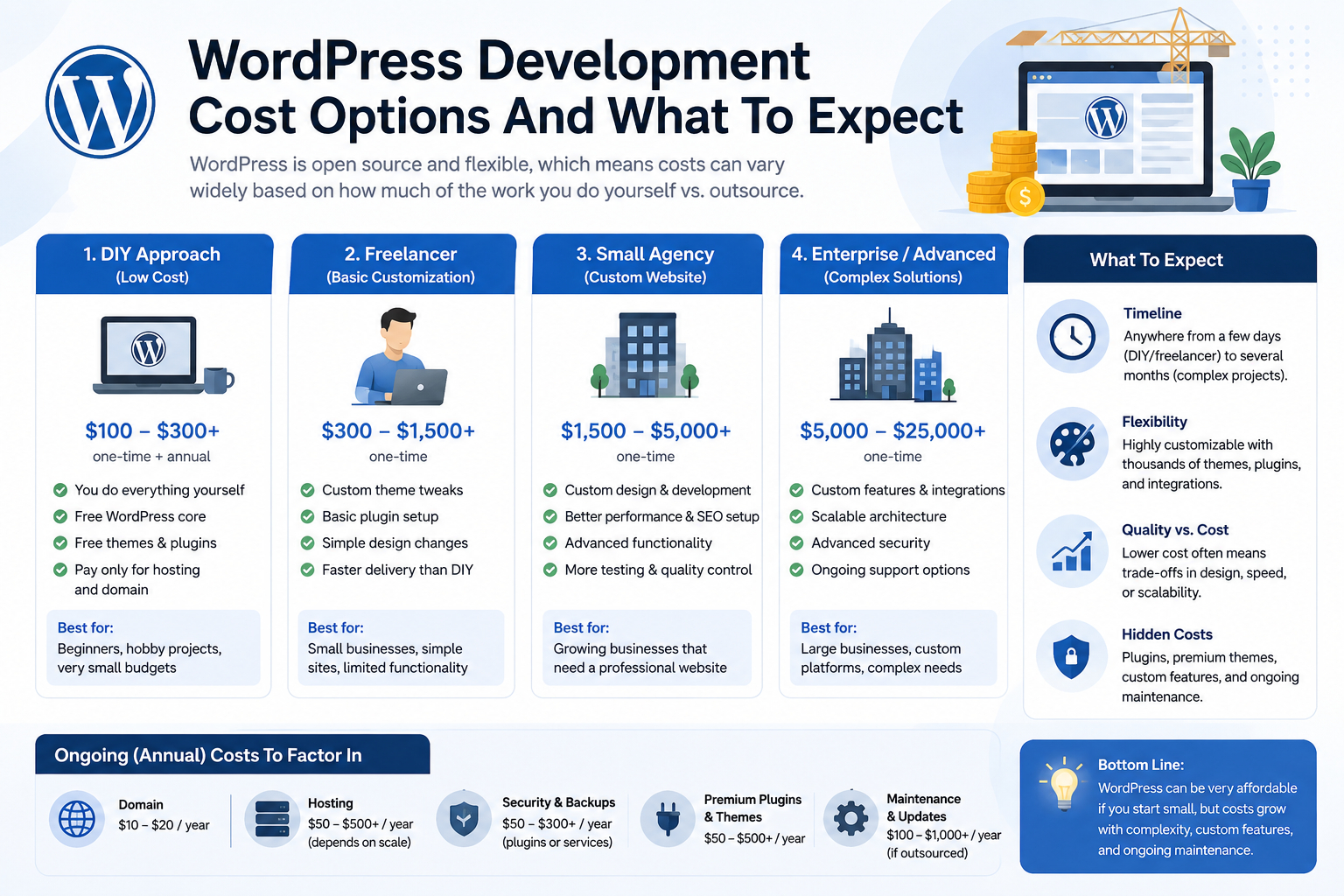
Exact pricing varies by region, complexity, and who you hire, but most serious business WordPress projects fall into a few practical tiers:
- Lean starter site: $1,000–$3,000. For small businesses needing a simple brochure-style site. Typically includes a premium theme, 3–6 core pages, basic on-page SEO setup, and standard contact forms. Content is usually client-provided and custom features are limited.
- Growth-focused site: $3,000–$8,000. For businesses wanting a more polished brand presence, better UX, and stronger lead generation. Expect a custom-designed homepage, performance optimization, conversion-focused forms, basic tracking setup, and initial SEO structure.
- Custom or conversion-led build: $8,000–$20,000+. For organizations treating their website as a core sales or marketing asset. Includes UX strategy, a custom design system, custom Gutenberg blocks, CRM and marketing tool integrations, Core Web Vitals optimization, and robust QA.
- Enterprise or complex platforms: $25,000–$100,000+. For larger sites with multi-language support, membership portals, advanced search, or headless WordPress architectures. Expect multi-phase discovery, detailed technical architecture, compliance work, and ongoing retainers.
These are planning anchors, not price quotes. They help you understand how different scopes map to very different cost realities before you speak to a single developer.
The WordPress Cost Architecture Framework
Most budget confusion comes from treating a website as a single line item. In practice, a successful WordPress project moves through predictable phases. Understanding these phases helps you read proposals correctly and compare options like-for-like.
Phase 1: Discovery and Strategy
This is the alignment phase before any design or code is written. It covers stakeholder goals, sitemap and information architecture, content inventory, and technical requirements such as integrations, languages, and performance targets.
For smaller sites, discovery is often bundled into the overall price. For larger projects it can be a distinct line item ranging from a few hundred to several thousand dollars. Skipping discovery entirely is the most reliable path to scope creep and expensive change orders mid-project.
Phase 2: Design System and UX
Modern WordPress development is less about picking a pretty theme and more about building a reusable design system compatible with the block editor. This phase covers brand-aligned styles, key page layouts, mobile-first design, navigation and call-to-action decisions, and reusable block patterns.
Basic brand skinning can be modest in cost. A full custom UX and design system can represent 20–40% of the total project budget, especially for conversion-focused sites. Block themes and Full Site Editing (FSE) reduce reliance on heavy page builders but demand more deliberate upfront design work for blocks and patterns.
Phase 3: Development and Integrations
This is where approved designs become a working, maintainable WordPress site. Key cost drivers include the number of unique page templates, any custom post types, custom logic such as calculators or quoting forms, and integration complexity with external APIs, CRMs, or email platforms.
AI-assisted coding can accelerate boilerplate tasks, but complex integrations, security hardening, and nuanced UX logic still require experienced developers. Do not expect a custom build to be cheap simply because AI tools exist—the savings appear in repetitive scaffolding, not in architectural decision-making.
Phase 4: QA, Performance, and Launch
A properly budgeted project includes dedicated time for cross-browser and device testing, performance benchmarking against Core Web Vitals thresholds, accessibility checks, security hardening, and a staged launch process. Cutting this phase to save money almost always produces post-launch rework that costs more than the savings.
Phase 5: Post-Launch Maintenance and Growth
WordPress is not a one-time expense. Ongoing costs to budget for include managed hosting ($30–$300/month depending on traffic and requirements), WordPress core, theme and plugin updates, security monitoring, backups, and periodic performance audits. Many agencies now offer retainer packages that bundle these services with proactive SEO and conversion rate optimization work.
Hidden Costs That Catch Businesses Off Guard
Even a well-scoped proposal can leave out line items that add up quickly. Watch for these commonly overlooked expenses:
- Premium plugins and licenses. Tools for forms, SEO, e-commerce, performance, or membership can add $200–$1,500 per year in recurring license fees.
- Stock photography and media. Professional image libraries or custom photography are rarely included in development quotes.
- Compliance and accessibility. Increased regulatory scrutiny around accessibility (WCAG) and data privacy (GDPR) has made compliance testing a mandatory budget line item for any business with international or regulated audiences. Retrofitting accessibility after launch costs significantly more than building it in from the start.
- Content creation and migration. Moving existing content from another platform or CMS, or creating new page copy, is almost always a separate cost from development.
- CDN and managed hosting upgrades. Managed WordPress hosting and CDN services have shifted from optional extras to essential infrastructure for performance and security baselines. Budget $50–$300/month for a serious business site.

Freelancer vs. Agency: How the Cost Comparison Actually Works
The cheapest quote is rarely the most cost-effective option. Here is a practical framework for evaluating your options:
- Freelancers ($30–$150/hour): Best for well-defined, smaller scopes where you can actively manage the project. Risk increases with project complexity, as a single freelancer may lack design, development, and SEO depth simultaneously.
- Boutique agencies ($80–$200/hour): Offer a team covering design, development, and strategy under one engagement. Better suited for growth-focused or custom builds where alignment across disciplines matters. Adspheregroup operates in this space, offering WordPress development alongside SEO strategy and e-commerce development under a single project framework.
- Large agencies ($150–$300+/hour): Appropriate for enterprise projects with complex governance, multi-stakeholder approvals, or global compliance requirements. Overhead costs are higher and project timelines tend to be longer.
When comparing quotes, always confirm what is included in post-launch support, who owns the code and design assets, and how change requests are scoped and billed.
How to Evaluate a WordPress Quote Before You Sign
A reliable proposal should answer these questions without you having to ask:
- Does it break costs down by phase, not just a single total?
- Are plugin licenses, hosting, and third-party tools listed separately or bundled?
- Is there a defined change order process with clear billing terms?
- What deliverables trigger each payment milestone?
- What does post-launch support include and for how long?
- Who retains ownership of the final theme, code, and design files?
If a quote is vague on any of these, request clarification in writing before work begins. Scope ambiguity at the proposal stage is the primary cause of budget overruns in WordPress projects.
Mapping Budget to Business Outcomes
The most useful question is not “what is the cheapest WordPress site I can get” but “what does this investment need to return?” A $5,000 site that generates consistent qualified leads pays back faster than a $1,500 site that requires a complete rebuild in 18 months.
Define your primary success metric before briefing any developer: is it lead volume, revenue from e-commerce, lower customer acquisition cost, or brand credibility? Share that metric in your brief. A development partner worth working with will design the project scope and architecture around that outcome, not just a feature list.
At Adspheregroup, our WordPress development engagements are structured around business goals from the discovery phase forward. If you are ready to scope a project or need a second opinion on an existing quote, get in touch with our team.